 Live Well Erie
Examining health equity and mobility in Erie County, NY
Introduction & Background
Mobility plays a critical role in shaping the quality of life in Erie County, New York. As Erie County continues to develop, disparities in access to reliable transportation, safe infrastructure, and economic opportunity remain significant, particularly for historically underserved communities. In both urban centers like Buffalo and the more rural surrounding areas, limited public transit options, aging infrastructure, and socio-economic barriers contribute to mobility challenges. This particularly affects those who don’t have access to or are unable to drive a private vehicle. Addressing these challenges is essential not only for improving transportation access but also for advancing social and economic well-being and supporting the health of all residents across Erie County. This page examines the accessibility of transportation and mobility for all Erie County residents, as well as the impacts of transportation infrastructure, and underscores the need for inclusive, community-focused solutions.
The Social Determinants of Health & Transportation
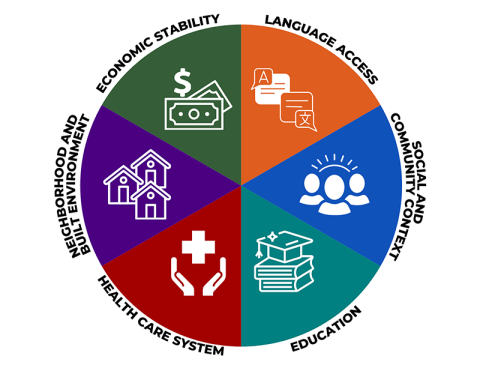
Social determinants of health (SDOH) are factors that influence a person’s health, outside of their genetic and biological make-up. Health disparities are largely the result of inequities within the SDOH. Below is a model of SDOH that displays six domains. SDOH factors are often categorized into these domains. For example, transportation is categorized in the Neighborhood and Built Environment domain. Though these categories are used to illustrate the scope and breadth of the impact of the SDOH, it is critical to not think of these factors as silos.
For more information on SDOH visit the LWE story page
Transportation Means, Access, and Limitations in Erie County
The sections below explore:
- How residents get around
- Challenges to accessing transportation
- Challenges due to lack of transportation
How do you get around?
Data from the ECOHE 2022 Health & Wellness Survey
See how living with a disability and other demographic factors impact transportation by exploring the responses using the filters.
Hover over each circle for additional information. Use the filters to further explore the data.
Use of Personal Vehicles
Hover over each section for additional information. Use the filters to further explore the data.
Hover over each section for additional information. Use the filters to further explore the data.
Use of Public Transportation
NFTA Bus Routes in Erie County, NY (Summer, 2025)
What are the challenges to accessing transportation?
Compare what resident with and without a disability said were their challenges to getting around. Data from the ECOHE 2022 Health & Wellness Survey
Hover over each circle for additional information. Use the filters to further explore the data.
Mobility needs and challenges vary from person to person depending on factors such as place of residence, financial security, and disability status.
Hover over each circle for additional information. Use the filters to further explore the data.
Access to transportation is essential for meeting daily needs. Results from the 2025 Live Well Erie survey show getting to work, attending medical or personal appointments, and shopping for essentials are the most common transportation needs. Without reliable transportation, individuals may face barriers to employment, healthcare, and basic living necessities.
Lack of transportation has been a barrier to:
Compare what residents with and without a disability said that lack of transportation was a barrier to. Data from the ECOHE 2022 Health & Wellness Survey
Hover over each circle for additional information. Use the filters to further explore the data.
62%
of respondents with a disability reported at least one challenge due to lack of transportation, while only 41% of respondents without a disability reported at least one challenge due to lack of transportation.
If respondents reported a disability, they were asked a follow-up question to indicate what type or types of disability they had. The bar chart above displays the percentage of respondents who reported at least one challenge due to lack of transportation by disability type.
Transportation Means, Access, and Limitations by ZIP Code:
Explore the map to see how people said they get around by ZIP Code as well as barriers and challenges to transportation for each ZIP Code. Use the filters to see how other demographics impact transportation methods, barriers and challenges. Data from the ECOHE 2022 Health & Wellness Survey.
Many ZIP Codes have fewer than 10 respondents. Therefore, the counts depicted on the map may not be representative of the community within these areas.
Other Transportation Resources
NFTA Metro Public Transit (Bus & Rail): Interactive System Map
The Niagara Frontier Transportation Authority (NFTA) runs Buffalo’s buses and Metro Rail. The NFTA website includes an interactive transit map where you can view routes, schedules, and service information for both buses and rail across Buffalo and Erie County.
NFTA Transit Development Plan: This planning document contains analysis of transit usage, system performance data, and future service changes.
Greater Buffalo–Niagara Regional Transportation Council (GBNRTC): Maps & Data
GBNRTC is the official metropolitan planning organization for Erie & Niagara Counties.
Their Maps & Data section includes:
- An online bicycle infrastructure map showing bike lanes, racks, trails and more.
- An interactive Transportation Improvement Projects map of planned and ongoing projects.
- A Transportation Data Management System (TDMS) for traffic count and movement data.
GBNRTC Metropolitan Transportation Plan (LRTP)
The Moving Forward 2050 plan outlines long-term goals for transportation investment in the region and can include visual summaries of plans and needs.
Open Data Buffalo
The City of Buffalo’s official open data portal provides interactive charts, maps, and datasets about government operations and services, including transportation-related data.
Users can access neighborhood mobility data, create custom visualizations, and explore transit statistics.
Erie County GIS Interactive Mapping
Erie County offers an Interactive Mapping Viewer where you can overlay road networks, streets, and other GIS layers.
Rural & Greater WNY Transit (Go Buffalo Niagara)
The Go Buffalo Niagara website includes information and maps for regional transit services beyond NFTA, including rural routes and commuter options.
Go Buffalo Niagara also has a transportation report that includes context on travel demand and infrastructure goals.
Efforts and Initiatives
Live Well Erie Transportation focused initiatives Initiatives Grant
Scroll through information below on the recipients of LWE Initiatives Grants with projects that focus on transportation. Visit the LWE story page for the full list of LWE grant funded projects.
Go Bike Buffalo
GObike is an organization dedicated to creating safe, connected, and sustainable communities through biking, walking, and other mobility options. Their mission is to inspire cultural and behavioral shifts toward healthy, sustainable lifestyles, ensuring equitable access to these opportunities for all residents of Western New York. GObike has been instrumental in developing Safe Routes to School, aiming to make walking and biking the safest and most preferred modes of transportation for children.
Funded Project: The Bike Bus
The Bike Bus project involves a group of children cycling to school together with adult chaperones, promoting active transportation, community engagement, and health. By following a predetermined route with designated meeting points, the project aims to improve physical and mental well-being, enhance cognitive skills, and foster social connections, while instilling a lifelong love of cycling in the next generation.
The Rural Outreach Center
The Rural Outreach Center (ROC) is dedicated to breaking the cycle of rural poverty by empowering individuals and families toward self-sufficiency. Using a two-generational approach, ROC provides care coordination, financial literacy, mental health counseling, play therapy, academic tutoring, and workforce development. Their goal is to help participants improve their housing, income, and emotional stability, with a focus on long-term, measurable outcomes.
Funded Project: Rural Development Hub
The expansion of the Rural Development Hub will address key challenges in southern Erie County, focusing on affordable housing, food insecurity, transportation, and workforce development. The project integrates support services like mental health counseling, financial literacy, and care coordination, aiming to break the cycle of rural poverty and empower families toward self-sufficiency and improved well-being.
Rural Transit Service
The funding for the Rural Transit Service allowed for the replacement of an existing vehicle to ensure continued transportation services across Erie County. Reliable transportation helps residents, particularly older adults, individuals with disabilities, and rural community members, access healthcare, employment, and essential services.
Additional information about other LWE efforts and initiatives is available on the LWE Story page.
Data Sources
Below is a list and additional information on all of the data sources used within this webpage.
Live Well Erie Community Survey
In 2024, Live Well Erie received over 750 responses to a community survey conducted to better understand the barriers individuals face regarding mobility, housing, and access to childcare. Insights from the survey aim to guide the development of more inclusive policies and programs that address these challenges. Read a summary of the survey results.
Erie County Office of Health Equity 2022 Health and Wellness Survey
Shortly after its inception in December of 2021, the Erie County of Health Equity (ECOHE) conducted a survey to gather current and local information on how the diverse communities in Erie County experience the social determinants of health (SDOH). This survey included questions pertaining to the means of transportation used by participants, barriers to transportation, and challenges due to lack of adequate transportation. In total, ECOHE collected over 3,451 survey responses. Read the full report summarizing the survey and its findings.
Erie County Office of Health Equity 2023 Focus Groups
To supplement the 2022 Health and Wellness Survey data with more nuanced and in-depth information, the ECOHE conducted a series of 14 focus groups with specific demographic communities within Erie County. Transportation challenges were discussed in 9 of these groups. Read the full report summarizing the focus groups and its findings.
Erie County 2025-2030 Community Health Assessment (CHA) Research
Every 6 years, NYS requires all counties to conduct a Community Health Assessment and Community Health Improvement Plan. The 2025-2030 CHA-CHIP is also focused on SDOH factors, including transportation. In addition to gathering information from existing data sources, the ECOHE and its local hospital partners used various methods to ask members of the community which health conditions and SDOH factors should be prioritized for improvement. These methods included:
- A survey with 2,510 responses,
- 4 focus groups,
- 5 interviews with participants (parents) in the Children Youth with Special Health, Care Needs Program, and
- 8 Interviews with medical providers who practice in Erie County.
While transportation was not ultimately selected as an issue of focus for the CHIP, 34% of survey respondents indicated that it was in their top 5 priorities. Transportation challenges were also highlighted in many of the CHA focus groups and interviews. Transportation was also discussed as a factor related to the issues that were selected: mental health, nutrition security, housing, and unemployment.
The full CHA report will be released at the end of 2025
US Census Bureau
The U.S. Census Bureau’s American Community Survey (ACS) is an ongoing annual survey that collects detailed information about how people in the United States travel to work. Its transportation data include variables such as means of transportation to work (e.g., car, public transit, walking, biking, telecommuting), average travel time, departure time, vehicle availability, and carpooling habits. These data are available at multiple geographic levels—from national and state to county, place, and ZIP Code—and are widely used by planners, policymakers, and researchers to understand commuting patterns, assess transportation equity, and guide infrastructure and transit planning. The data can be explored on the Census Bureau’s ACS Data Portal.
Comments or Feedback? Live Well Erie Homepage Email Live Well Erie