 Live Well Erie
Introduction & Background
Live Well Erie is a broad-based, data-driven initiative involving numerous partners in the public, private, and non-profit sectors collaborating to achieve greater health outcomes and improving the overall quality of life for its residents.
The Social Determinants of Health & Transportation
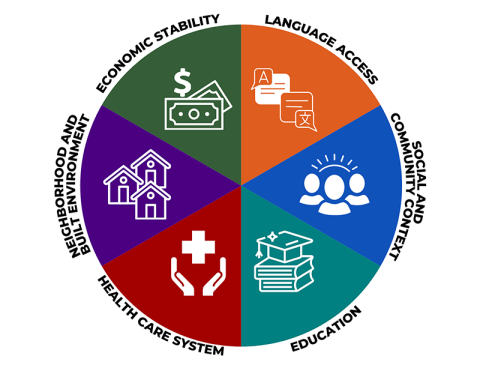
Social determinants of health (SDOH) are factors that influence a person’s health, outside of their genetic and biological make-up. Health disparities are largely the result of inequities within the SDOH. Below is a model of SDOH that displays six domains. SDOH factors are often categorized into these domains. For example, transportation is categorized in the Neighborhood and Built Environment domain. Though these categories are used to illustrate the scope and breadth of the impact of the SDOH, it is critical to not think of these factors as silos.
Scroll through each of the SDOH domains below to explore what Erie County residents have shared about how transportation relates to challenges within these categories.
Economic Stability
In the 2022 ECOHE Health and Wellness Survey, the challenge to accessing transportation that was selected the most was affordability.
Also, in the 2022 ECOHE Health and Wellness Survey, about 10% of respondents reported that lack of adequate transportation was a challenge to obtaining and/or maintaining employment.
“I hit a deer and I don't have a reliable car and then it trickles down. I can't get a job and I can't provide for my kids. And then they can't have a happier, stable, stable life, you know? I mean, like, I can rely on friends for rides [...], but if I don't have a reliable vehicle or transportation to get to places, then I can't have a stable job.”
2023 Focus Group Participant
“I had moved into the city for my services to decrease my travel costs.”
2023 Focus Group Participant
Language Access
In the 2022 ECOHE Health and Wellness Survey, 50% of the respondents who indicated that they speak English not well or not at all reported no use of a personal vehicle to get around while 31% of respondents who indicated that they speak English well or very well reported no use of a personal vehicle.
A medical provider interviewed for the 2025-2030 Community Health Assessment (CHA) discussed how lack of language access for non-English speakers is a challenge at every step of pursuing health care, including communicating to cab or rideshare drivers where to go for medical appointments.
Health Care System
In the 2025 CHA research, multiple participants, including health care providers discussed transportation challenges to accessing health care, including:
- Some patients have challenges getting to the specialists their primary doctors refer them to, especially if they are located outside of the city
- Medicaid cabs are helpful in getting eligible patients to their appointments but do not transport them to pick up medications or healthy foods that the doctors recommend
- Bus routes are often not adequate to get to doctors' offices
- Often people call for ambulances for non-emergencies to get them to the hospital, due to a lack of other transportation. This may cause a shortage of ambulances for actual emergencies
“They do have Medicaid cabs, [..] if you have Medicaid [...] Some of them won't take children. So, if you have a doctor's appointment, you have a two year old, they won't let the two-year-old travel because they don't have liability coverage [...] for that. But then also, [...] the Medicaid cab, they come 45 min late, they pick you up and now you get to the doctor's office, they're like, oh, you're 44 minutes late. Now you gotta reschedule and you might have to pay a fee. And then you still have to worry about how to get back because your Medicaid cab isn't scheduled to take you take them back home for another hour, hour and a half. So, it's a great idea, it just needs to work more efficiently.”
CHA Focus Group Participant
“You have families that are living in poor neighborhoods and have no choice but to go to one specific doctor because that's what they can get to by transportation. But then just outside the city limits in Clarence, Depew, Williamsville, you have all these doctors that have all this availability and all these openings, but they only see the people that can get there.”
2023 Focus Group Participant
Social & Community Context
In the 2022 ECOHE Health and Wellness Survey, respondents who reported using a personal vehicle to get around rated their social supports (having people to rely on for emotional support, practical help, and having fun) as more sufficient than those who reported using other means of transportation.
“We have nothing down here. We have a medical van that'll take you to medical appointments if the van's running by and [can] get you. We have no way of getting [...] to the local grocery store, just to socialize with people. That's the whole thing. Socialization is one of the biggest things that affect your health. And people don't realize it if you can't get out. And just the idea of talking to somebody. How that uplifts your spirits. So, you want to eat, you want to get out. You want to do things. We are very, very isolated here that way.”
2023 Focus Group Participant
“It's difficult to go places if you can't afford a bus ticket or gas. It's difficult to go out and find community if you can't afford the transportation to get there.”
2023 Focus Group Participant
Education
A mother who lives in the City of Buffalo, interviewed for the 2025-2030 CHA noted that when her children lose their bus passes, they are denied transportation to school. Meanwhile, a shortage of school bus drivers throughout the county has caused many students to miss time at school.
56%
of respondents without a college degree reported challenges due to lack of transportation. This is compared with only 18% of respondents with a college degree reported having challenges due to lack of transportation.
In the 2022 ECOHE Health and Wellness Survey, 18% of respondents with a college degree reported having challenges due to lack of transportation while 56% of respondents without a college degree reported challenges due to lack of transportation.
Neighborhood & Built Environment
Participants in both the 2023 Focus Groups and the 2025 CHA Focus Groups discussed how the public transportation infrastructure in Erie County is inadequate for those who rely on it. Challenges that were highlighted include:
- Limited bus routes, particularly outside the city
- Limited bus schedule
- Lack of adequate shelters or benches at many bus stops
- Lack of accommodations for people with disabilities
“Limited transportation for those who don't drive [is a challenge]. Especially on weekends, the bus does not go by my house like it usually does. So, if I wanted to go somewhere on the weekends, I better hope someone can take me there. Or like if I wanted to do overtime or if I wanted to do anything on the weekend. Also, certain hours where the bus does not run in my neighborhood so I'm very limited on when I can and can't go to and from work by myself. And the extent of the bus routes, pretty much [...] stops in Transit. I feel like Transit, Amherst, Cheektowaga area is pretty much where the bus routes die off.”
2023 Focus Group Participant
“I have to say, of transportation it is almost impossible to find a bus that is able to accommodate me and my ridiculously large service dog. He's 150 pounds, so he's a big boy and I get yelled at all the time that my dog can't be in the aisle. But they're cramming everybody like sardines and they don't run often enough to just say, Hey, we have a wheelchair person on this bus, can you catch the next one. Or they'll tell me, Oh, a wheelchair, Sorry, the bus is full. I'm in the rain or in the snow.”
2023 Focus Group Participant
Community research participants in the rural areas noted that people who don’t drive have difficulty accessing grocery stores, which are often miles away. While bus routes may not be practical for those areas, they are in need of a solution for the lack of transportation.
“I live in a really rural area. There's no bus. There's no taxis around. There's no public transportation. Luckily, I have a Top's two miles away. That's a two-mile walk. [...] And I found out my local pharmacy doesn't have the drugs I need. So, I had to go all the way to Hamburg to get [them]. Luckily, me and my partner, we share a vehicle, so we can get around -but it's his vehicle, you know. If he's using it, I have no transportation.”
2023 Focus Group Participant
Visualize Erie County SDOH Data
Use the drop downs on the map below to explore SDOH data by ZIP code in Erie County.
Some ZIP codes have fewer than 10 respondents. Therefore, the rates depicted on the map may not be representative of the community within these areas.
Efforts and Initiatives
Grants
The Live Well Erie Initiatives Award provides one-time grant funding to Erie County nonprofit organizations for innovative community-based projects that strengthen health, stability, and opportunity for children, working families, and older adults. The award supports collaborative, equity-focused initiatives designed to create lasting, positive change across the community.
Projects funded through the Live Well Erie Initiatives Award advance three priority areas: Give Every Child a Chance to Succeed, Empower Working Families, and Support for Our Seniors. Supported efforts may include new or expanded programs, organizational capacity building, or investments in facilities and equipment that improve the overall well-being for Erie County residents.
Scroll through information below on the recipients of the LWE Initiatives Grants and a short description of their current projects or click on the year below.
2025 Grants
Belmont Housing Resources for WNY
Belmont Housing Resources for WNY helps families find and maintain affordable housing through property redevelopment, homebuyer education, and rental assistance programs. As the largest HUD-certified housing counseling agency in the region, Belmont serves over 2,500 households annually, offering support in areas such as financial management, foreclosure prevention, and home maintenance. They also focus on health and safety through initiatives like the Lead Hazard Control Program and the Green and Healthy Homes Initiative.
Funded Project: 2-Generation
Their 2-Generation (2-Gen) program helps working families achieve stable housing and financial security, supporting children in safe, stable environments. Through financial coaching, housing assistance, and homeownership guidance, the program helps families avoid homelessness, maintain employment, and build long-term wealth and stability.
Beyond Support Network of WNY
Beyond Support Network provides vital services to over 1,200 individuals across Western New York each year, focusing on helping people with disabilities achieve independence. Through a variety of programs, Beyond offers a comprehensive range of services, including housing assistance, vocational training, and health services.
Funded Project: LEAD716
The LEAD716 program provides early academic intervention for preschool children diagnosed with elevated blood lead levels. Focused on children ages 0-5, LEAD716 helps assess and address learning delays caused by lead exposure, offering targeted educational strategies and social-emotional learning (SEL) support.
Center for Elder Law and Justice
Center for Elder Law and Justice (CELJ) provides free legal services to older, disabled, and low-income adults in Western New York. Their comprehensive approach includes elder abuse prevention, healthcare advocacy, housing, and financial management, helping individuals maintain independence and dignity. CELJ also offers non-legal services like budgeting assistance through their Financial Management Program.
Funded Project: Legal Services Outreach Initiative
The Live Well Erie Legal Services Outreach Initiative aims to increase awareness and access to legal protections for underserved seniors in rural Erie County. With funding for an Outreach Coordinator and essential materials, this project will connect isolated seniors to critical services that impact their health, including housing stability, financial security, and protection from abuse.
Delevan Grider Community Center
Delavan-Grider Community Center (DGCC), operated by Metro CDC, is committed to enhancing the welfare of individuals in the Masten District of Buffalo through a variety of youth, senior, and community-focused programs. Since its founding in 2001, DGCC has provided crucial services like licensed childcare, youth mentorship, and senior adult activities.
Funded Project: Centering Our Teens
The Centering Our Teens program aims to create a safe and supportive space for teenagers in the Masten District. With a focus on health, well-being, and academic success, the program offers activities such as healthy cooking classes, fitness sessions, and youth boxing. The initiative seeks to engage 200 teens annually, addressing the challenges of poverty, food insecurity, and violence while promoting healthier behaviors and positive life outcomes.
Family Help Center
Family Help Center (FHC) is a nonprofit organization dedicated to preventing child abuse and providing support to families facing parenting challenges. FHC has been a leader in the community for over five decades, offering a variety of programs such as child welfare services, early childhood education, and the Grand-Families Program, which supports kinship families raising grandchildren.
Funded Project: Gram’s Clubhouse
The Gram’s Clubhouse project aims to transform an under utilized 5,000 sq ft space into a therapeutic and multi-purpose area for the Grand-Families Program. This will allow FHC to serve more families, reduce waitlists, and expand services like respite care. The renovated space will also be available for use by other community organizations, fostering greater collaboration and support for Erie County’s families.
Go Bike Buffalo
GObike is an organization dedicated to creating safe, connected, and sustainable communities through biking, walking, and other mobility options. Their mission is to inspire cultural and behavioral shifts toward healthy, sustainable lifestyles, ensuring equitable access to these opportunities for all residents of Western New York. GObike has been instrumental in developing Safe Routes to School, aiming to make walking and biking the safest and most preferred modes of transportation for children.
Funded Project: The Bike Bus
The Bike Bus project involves a group of children cycling to school together with adult chaperones, promoting active transportation, community engagement, and health. By following a predetermined route with designated meeting points, the project aims to improve physical and mental well-being, enhance cognitive skills, and foster social connections, while instilling a lifelong love of cycling in the next generation.
Say Yes Boys & Men of Color
Say Yes Buffalo (SYB) works to remove barriers to educational attainment and economic mobility for students in Buffalo, NY. Through a collective impact partnership, Say Yes provides a universal postsecondary tuition scholarship and cradle-to-career supports aimed at increasing high school graduation and college completion rates. Since its founding, Say Yes has awarded over $26 million in scholarships and contributed to a 25-percentage-point increase in high school graduation rates.
Funded Project: Mental Health and Wellness for Boys & Men of Color
The Mental Health and Wellness for Boys and Men of Color Initiative aims to support the mental and physical well-being of boys and men of color in Erie County, with a focus on Buffalo. This initiative will offer culturally relevant programs such as Barbershop Talks, fitness-focused series, and a Men’s Mental Health & Wellness Summit to empower participants to prioritize their health and model healthy masculinity.
Stitch Buffalo
Stitch Buffalo empowers refugee and immigrant women through textile arts training, offering opportunities to earn income while promoting creativity, inclusion, and environmental sustainability. Founded in 2014, the organization serves over 200 women annually, providing access to tools, materials, and a platform to sell their handcrafted goods.
Funded Project: Textile Art Training for Refugee Women
The Textile Art Training for Refugee Women project will expand Stitch Buffalo's successful textile arts training by offering courses in embroidery, sewing, dyeing, and weaving to help refugee women develop entrepreneurial skills. Graduates will create and sell handmade items through the Stitch Buffalo boutique, website, and wholesale partners, or launch their own micro-enterprises.
The Rural Outreach Center
The Rural Outreach Center (ROC) is dedicated to breaking the cycle of rural poverty by empowering individuals and families toward self-sufficiency. Using a two-generational approach, ROC provides care coordination, financial literacy, mental health counseling, play therapy, academic tutoring, and workforce development. Their goal is to help participants improve their housing, income, and emotional stability, with a focus on long-term, measurable outcomes.
Funded Project: Rural Development Hub
The expansion of the Rural Development Hub will address key challenges in southern Erie County, focusing on affordable housing, food insecurity, transportation, and workforce development. The project integrates support services like mental health counseling, financial literacy, and care coordination, aiming to break the cycle of rural poverty and empower families toward self-sufficiency and improved well-being.
Westside Community Services
West Side Community Services (WSCS) strengthens the West Side of Buffalo by supporting youth, families, and seniors, especially immigrants and refugees. Their mission is to foster community well-being and equity through programs in youth development, family engagement, mental health promotion, and aging services. With a focus on addressing barriers to opportunity, WSCS has expanded initiatives such as the West Side Teens program and the Provisions 139 Food Pantry, while also working to increase access for immigrant families and expand aging-in-place supports.
Funded Project: Telehealth Access Pilot
WSCS’s Telehealth Access Pilot aims to reduce health disparities for low-income seniors on Buffalo's West Side, particularly those who are homebound and have limited English proficiency. The pilot will provide in-person telehealth support through a bilingual Telehealth & Aging Support Coordinator, improving access to care, reducing hospitalizations, and helping seniors age in place.
2024 Grants
Big Big Table Community Cafe: Everybody Eats: Meal Tokens for Seniors
Everybody Eats: Meal Tokens for Seniors is a pilot initiative that expanded access to nutritious meals for older adults on Buffalo’s West Side. The project provided monthly meal tokens that help reduce cost barriers to healthy food while encouraging social connection in a community café setting.
Delavan Grider Community Center- Improving the Lives of Senior Adults Through Health and Wellness Programming and Activities
This project facilitated improvements to the Delavan Grider Community Center’s fitness center to better serve older adults in the Masten District. Equipment upgrades increased safety and usability, promoted physical activity, reduced social isolation, and strengthened the center’s role as a hub for healthy aging.
Feed Buffalo- Feed Buffalo Babies
Feed Buffalo Babies is a program focused on addressing childhood poverty through healthy food access and early literacy. The project maintained a food pantry manager, expanded culturally appropriate food options, distributed literacy materials, and hosted community conversations around nutrition, parenting, and early learning.
GLYS (Gay & Lesbian Youth Services of WNY)- The Family Support Service & Helpline
The Family Support Service & Helpline supports outreach and education efforts that promote health equity for LGBTQ+ youth and their families across Erie County. The project focuses on developing inclusive materials and engagement strategies that increase awareness, reduce barriers to care, and connect community members to health and wellness resources.
Grassroots Gardens- Community Garden Physical and Multilingual Accessibility Improvements
This funding supported the rebuilding of two long-standing community gardens to improve accessibility for individuals with disabilities and age-related mobility challenges. These improvements expanded healthy food access and supported older adults’ overall well-being.
No Wound Untreated- Our Mommies Village
Our Mommies and Mental Health is a program addressing the mental health needs of postpartum mothers of color in the City of Buffalo. The project provides culturally responsive, trauma-informed support, including group sessions, postpartum planning, coping skill development, and childcare during programming.
Parent Network of WNY- Kindergarten Readiness Series/Early Childhood Playgroups/Training for EI & CPSE Providers
This project supports multiple early childhood initiatives focused on developmental and education readiness for children in Erie County who are delayed or at risk of delay. The project includes kindergarten readiness programs, early childhood playgroups with developmental screenings, and professional training for early intervention and preschool special education providers.
Read to Succeed- Dolly Parton’s Imagination Library
This project supports the creation of an additional early literacy intervention specialist position to expand services in Community Action Organization Head Start classrooms on Buffalo’s East Side. This investment strengthens early reading skills and supports children during a critical stage of academic development.
Rural Transit Service
The funding for the Rural Transit Service allowed for the replacement of an existing vehicle to ensure continued transportation services across Erie County. Reliable transportation helps residents, particularly older adults, individuals with disabilities, and rural community members, access healthcare, employment, and essential services.
The Tool Library- The Healthy Homes Tool Borrowing Initiative
The expansion of the Healthy Homes Tool Borrowing Initiative created the capacity to expand access to tools, equipment, and educational workshops that help residents safely repair and maintain their homes. The project addresses health and safety risks associated with Buffalo’s aging housing stock and increasing extreme weather events.
Rural Outreach Center Affordable Housing Corporation- Affordable Housing Capacity Building Initiative
This program supported the creation of a Director of Affordable Housing position and advanced the development of a new affordable housing project in rural southern Erie County. The initiative addressed the shortage of rural housing options and works to reduce housing cost burdens for low-income households.
Belmont Housing Resources for WNY- Two Generation Family Housing and Financial Stability Program
Two Generation provides housing stabilization assistance for ALICE families experiencing financial hardship. The project provides help with security deposits and essential household items, enabling families to rehouse quickly and avoid homelessness.
PEDALS- Strengthening Early Childhood Developmental Screening Through the Early Educator Workforce
The program puts forth efforts to increase early childhood developmental screenings through integration of the PEDALS program into early childhood education settings. The project raises awareness of screening benefits, trains future providers, and works to reduce stigma so families can access early support for their children.
LWE Workgroup Events & Accomplishments
Early Childhood
Week of the Young Child
The Live Well Erie Early Childhood Workgroup supported Western New York’s NAEYC Week of the Young Child (April 5–11, 2025) by partnering with Help Me Grow WNY to host a series of free pop-up developmental screening events for children ages birth to 5, including stops at the Audubon Branch (Amherst) Library, the Buffalo Museum of Science, and the North Collins Public Library.
Families received quick, friendly screenings across key developmental areas (communication, movement, social-emotional skills, and learning), along with a free developmental toy or book to support learning at home. The week also included a Week of the Young Child proclamation and community partner engagement in support of early childhood wellness.
School-Aged Children
Youth Safe Space Certification
The School Age Workgroup achieved meaningful progress through the continued development of the Youth Safe Space Certification curriculum, an initiative designed to promote safe, inclusive, and supportive environments for school-age youth. The curriculum represents a significant advancement in the workgroup’s efforts to establish shared standards and practical tools that organizations can use to better support young people.
While the Youth Safe Space Certification curriculum is still a work in progress, the workgroup has made steady strides in shaping its structure and content. Ongoing refinement and partner engagement continue to strengthen the curriculum, including support from University at Buffalo public health students who are contributing to the development of a digital literacy component.
Working Families
Career Fairs
As part of Live Well Erie’s Working Families strategies, the group supported coordinated efforts to strengthen both workforce stability and housing affordability. In spring 2025, the New York State Department of Labor (NYSDOL) and the Buffalo and Erie County Workforce Investment Board (BECWIB) hosted a series of career fairs for dislocated Sumitomo Rubber USA workers, connecting participants with employers, job referrals, retraining options, and upskilling opportunities aligned with regional labor market needs. These events reflected Workforce Buffalo’s commitment to coordinated services and sustainable reemployment pathways.
That same commitment to addressing economic stability was reflected in Erie County’s 4th Annual Housing Summit, held November 14, 2025, at the Rural Outreach Center in East Aurora. The summit brought together municipal leaders, developers, planners, and residents to examine housing affordability, particularly in rural communities. Through panels, case studies, and localized data, participants explored practical strategies for developing small-scale, affordable housing and strengthening local capacity to address housing challenges across the region.
Older Adults
Retreat, Refresh, Restore
The Live Well Erie Retreat: Refresh & Restore on October 18, 2025, offered older adults a full day of engaging resources focused on health, wellness, civic engagement, and aging-related challenges. Coordinated by the Erie County Department of the Aging and Live Well Erie, this free event provided attendees with opportunities for personal growth and community connection.
Workshops and discussions covered a range of topics, including transportation, financial matters, technology, health insurance options, mental health, caregiver support, and aging in place. Participants also gained insights into fraud prevention, mindful practices, emergency preparedness, and more. With transportation available and lunch provided, this event fostered a supportive environment combating the stigma and navigating the challenges of aging.